
Best Basement Flooring: Choose the Right Option for Moisture
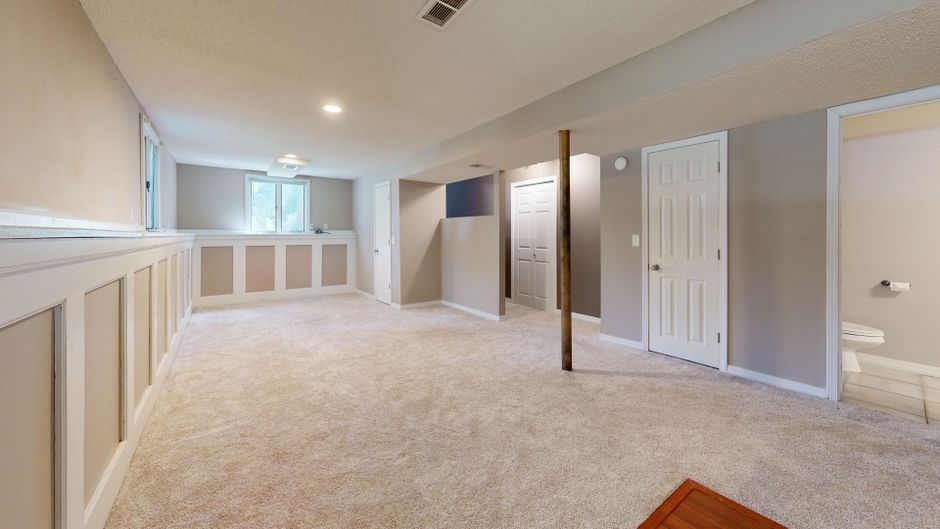
For a damp basement, start with the slab, not the finish: test its moisture and address water conditions before installing flooring. Ceramic tile and suitable coating systems can work over damp concrete when their system details fit the slab; vinyl plank, carpet tiles, and laminate require product-specific suitability and installation conditions. Choose by room use, and remember that a waterproof material does not make the entire floor system waterproof.
What flooring can I install over a basement concrete slab?
You can install flooring over a basement slab only when the slab’s moisture condition, preparation, and the chosen product’s requirements line up. The finish is the last decision in the chain. Excess moisture can undermine flooring and coatings, so a product label alone cannot settle whether the assembly is suitable.
According to ASTM International, its F2170 method measures relative humidity inside concrete floor slabs with in-situ probes. The standard warns that excessive moisture moving through concrete can cause flooring or coating systems to debond or deteriorate and can contribute to microbial growth. A test is a snapshot: its results indicate slab conditions only at the time of testing.
That snapshot matters because concrete can still contain construction moisture. Building Science Corporation explains that an under-slab gravel layer and polyethylene vapor-control layer do not remove water already in the concrete. Installing flooring, carpet, or tile before the slab has dried sufficiently can lead to mold, buckling, or lifted tile.
Use this sequence before picking a finish:
- Check the slab. Arrange appropriate moisture testing and review the results against the flooring and installation-system requirements.
- Resolve water pathways. Building Science Corporation’s foundation strategy is to control groundwater and capillary flow, limit water-vapor entry, and allow moisture that gets in to dry.
- Match finish to room use. A utility area, gym, or playroom has different comfort and maintenance priorities. The provided sources do not establish a universal winner for those uses, so use product specifications rather than assumptions.
- Confirm the whole assembly. Ask whether the flooring, adhesive, underlayment, and slab preparation are compatible together.
Tile illustrates why system details beat broad labels. Building Science Corporation describes ceramic tile as a practical finish over damp concrete. It also warns that vapor-impermeable vinyl tiles can trap moisture and put adhesive at risk. The material may tolerate water, but the adhesive and concrete interface still matter.
Is vinyl plank or tile better for a basement?
Tile has clearer support for use over a damp slab in the provided sources; vinyl plank may suit a basement only when its product and installation system address the slab’s moisture conditions. “Waterproof” describes a material or surface claim, not automatically a waterproof floor system.
A floor system includes more than the visible wear layer. Moisture can move through concrete and become trapped beneath a low-permeance finish. Building Science Corporation’s discussion of concrete floor problems specifically flags vapor-impermeable vinyl tile and adhesive risk. That is a reason to check the exact product instructions and installation method before treating vinyl as a safe default.
Tile has a different trade-off. Ceramic tile can be a practical finish over damp concrete, but premature installation over a slab that has not dried sufficiently can still contribute to lifted tile. The word “tile” does not cancel out slab preparation. Let the test and installation requirements decide whether this is the right moment to install.
Coatings also require system-level evaluation. Building Science Corporation identifies epoxy as one possible approach for certain wet-slab conditions, while emphasizing that slab and coating details matter. It is not a blanket fix for every basement. For a playroom, gym, or utility space, compare the candidate products on the documented conditions they allow, then weigh comfort and upkeep based on the manufacturer’s published information.
| Option | Who it suits | Cost | Key limitation |
|---|---|---|---|
| Ceramic tile | Basement projects where a practical finish over damp concrete is desired | not published | Premature installation over an insufficiently dried slab can contribute to lifted tile |
| Vinyl plank | not published | not published | Low-permeance vinyl can trap moisture and put adhesive at risk; verify the specific system |
| Laminate | Basements where the product’s site and subfloor conditions are met | not published | Suitability is product-specific, not universal |
| Carpet tiles | not published | not published | Installing carpet over a slab that has not dried sufficiently can contribute to mold |
| Epoxy coating | Certain wet-slab conditions, when slab and coating details fit | not published | System details matter; it is not a universal solution |
Can laminate flooring handle basement moisture?
Some laminate flooring can be installed in basements when the site and subfloor meet the specific product’s conditions; that does not make all laminate suitable for damp rooms. Check the exact installation guidance before buying, and treat moisture testing as a separate step rather than assuming a basement-rated label settles the question.
Shaw Floors says its laminate can be installed in basements when proper conditions are met. For its cited guidance, the HVAC system should be operational seven days before, during, and after installation. Indoor relative humidity should be between 35% and 65%, and temperature between 65°F and 85°F. The instructions also call for a 1/2-inch expansion space around the perimeter and fixed objects.
Those numbers are product guidance, not a universal rule for every laminate floor. Put the requirements in front of the installer before work begins: “Does this product’s basement guidance match the measured slab and the room conditions?” If the answer is unclear, pause and get the manufacturer’s requirements rather than filling gaps with general advice.
Wood flooring over concrete makes the same point. The National Wood Flooring Association says solid and engineered wood can be installed over concrete when the slab is properly prepared and manufacturer requirements are followed. Its checklist calls for a dry slab and appropriate moisture tests. It also specifies flatness tolerances of 1/8 inch within a 6-foot radius or 3/16 inch within a 10-foot radius, and recommends a vapor-retarding membrane with a perm rating of 0.13 or less.
Frequently Asked Questions
Do I need to test for moisture before installing basement flooring?
Yes. ASTM F2170 describes a method for measuring relative humidity inside concrete slabs, and the National Wood Flooring Association’s checklist calls for a dry slab and appropriate moisture tests. Results describe the slab only when tested, so they do not guarantee future conditions.
What basement flooring is easiest to replace if it floods?
The provided sources do not compare replacement effort after flooding for vinyl plank, tile, laminate, carpet tiles, or coatings. Check how the specific product and installation system are assembled and what the manufacturer permits before choosing.
Sources
What Should I Include in a Kitchen Remodel for Better Storage?
Plan kitchen storage around daily routines with practical choices for drawers, pullouts, pantry space, waste, outlets, and appliance access.
How Often Should You Pump a Septic Tank?
Learn how inspection results, tank size, household use, and warning signs help determine when to pump a septic tank.